

By Guardian Electrical Contractors LLC · Published .
Start with the property, not the mailing label
An address described as Myrtle Beach or Conway does not automatically place the property inside that city’s permitting jurisdiction. The ZIP code is useful for mail; it is not enough to select a building department. This guide covers Myrtle Beach, Conway and unincorporated Horry County, including Carolina Forest properties handled by the county. Confirm the exact address before relying on that general description.
Give the office the street address, parcel information if available and a plain-language description of the proposed electrical work. For another municipality or a Georgetown County property, confirm that jurisdiction’s process rather than using the nearest office in this guide. Guardian’s service area is broader than these three permitting authorities.

Inside the City of Myrtle Beach
The City of Myrtle Beach Construction Services Department handles city building and trade permitting, plan review and inspections. Its published directions send electrical and other trade-permit paperwork to permittech@cityofmyrtlebeach.com. The department’s main contact for trade permits and inspection questions is (843) 918-1111.
Start by confirming that the property is within city jurisdiction. Then ask which application and supporting documents fit the actual work, who should submit them and what inspection stages apply. The city’s page links its current forms and submission guidance. A trade permit, a building alteration and a utility’s requirements can be different parts of one project; do not assume one application settles every responsibility.
Inside the City of Conway
Conway Construction Services reviews building plans, issues permits and administers building-code requirements for the city. Its page provides a property-jurisdiction map specifically to help establish whether a property is in Conway’s jurisdiction.
The published department contact is (843) 488-9888, at 196 Laurel Street. The page directs submitted forms to building@cityofconway.com unless staff advises otherwise. Check the jurisdiction first and describe the work before selecting a form. For example, an electrical connection associated with a pool or an alteration may need coordination with the larger project; this guide does not determine which approvals a particular proposal requires.
Unincorporated Horry County and Carolina Forest
Horry County Code Enforcement identifies its permitting and inspection responsibility as construction and improvements in the county’s unincorporated area. Its office is at 1301 Second Avenue, Suite 1D09, Conway; the location of that county office does not make every project a City of Conway permit.
Contact the county at (843) 915-5090 or hcg.CodeEnforcement@horrycountysc.gov. Its page links the online portal and explains which listed residential work classes support online inspection scheduling; other permit types use the department’s stated phone process. Ask which route fits your permit instead of assuming every electrical inspection can be booked the same way.
Some work has a specific submittal, such as the county’s residential EV-charging checklist. For the underlying capacity question, our EV charger and panel-capacity guide explains what information helps an assessment.
A hypothetical address check
Suppose an owner gives a Myrtle Beach mailing address for a Carolina Forest project. Before an application is prepared, the exact parcel is checked and the responsible department confirms jurisdiction. If it is unincorporated Horry County, the county process applies; if the property is within another authority’s boundary, the inquiry goes there.
This is an example of the checking process, not a boundary determination for your address. For a renovation, include any existing building-permit contact so the electrical portion can be coordinated rather than treated as an unrelated job.
Settle these questions before the work is scheduled
- Scope: What installation, repair or alteration is actually proposed?
- Submission: Who prepares the application and the supporting plans or equipment documents?
- Approval: What needs to be accepted before this work starts?
- Inspection: Which stages are required, and who requests and records them?
- Power: Is a utility interruption or reconnection involved, and who coordinates it?
- Handover: What permit and completion records will the owner receive?
Keep permit status, the electrician’s work and utility scheduling distinct. Ask for the agreed responsibilities in the estimate, including access and any work by other trades. Fees, exemptions, document requirements and timing depend on the authority and scope; confirm them directly instead of treating an online example as approval.
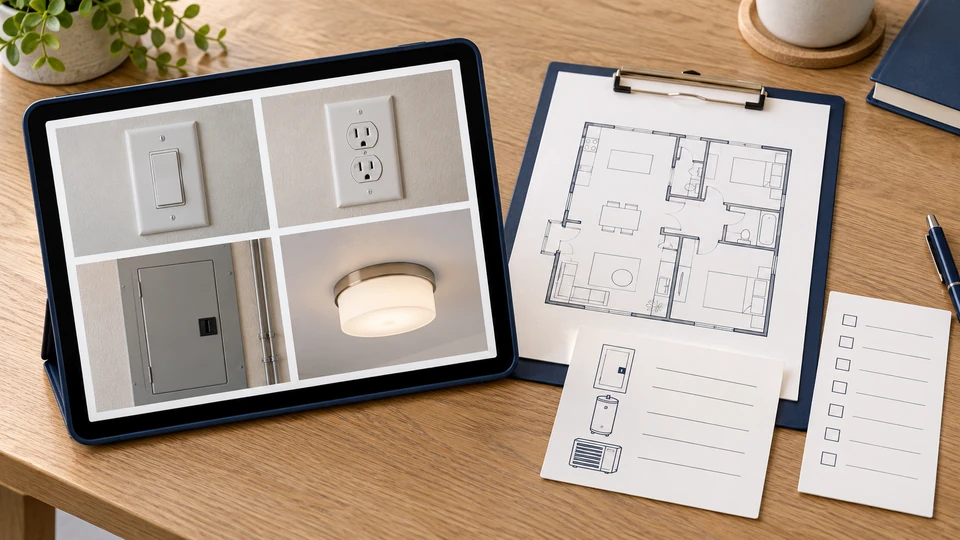
Our electrical visit checklist helps organize the information. Send Guardian the address and project description so the scope and responsible contacts can be discussed together.